Vastu Shastra vs Astrology or other birth chart reading methods : Understanding their TRUE relationship
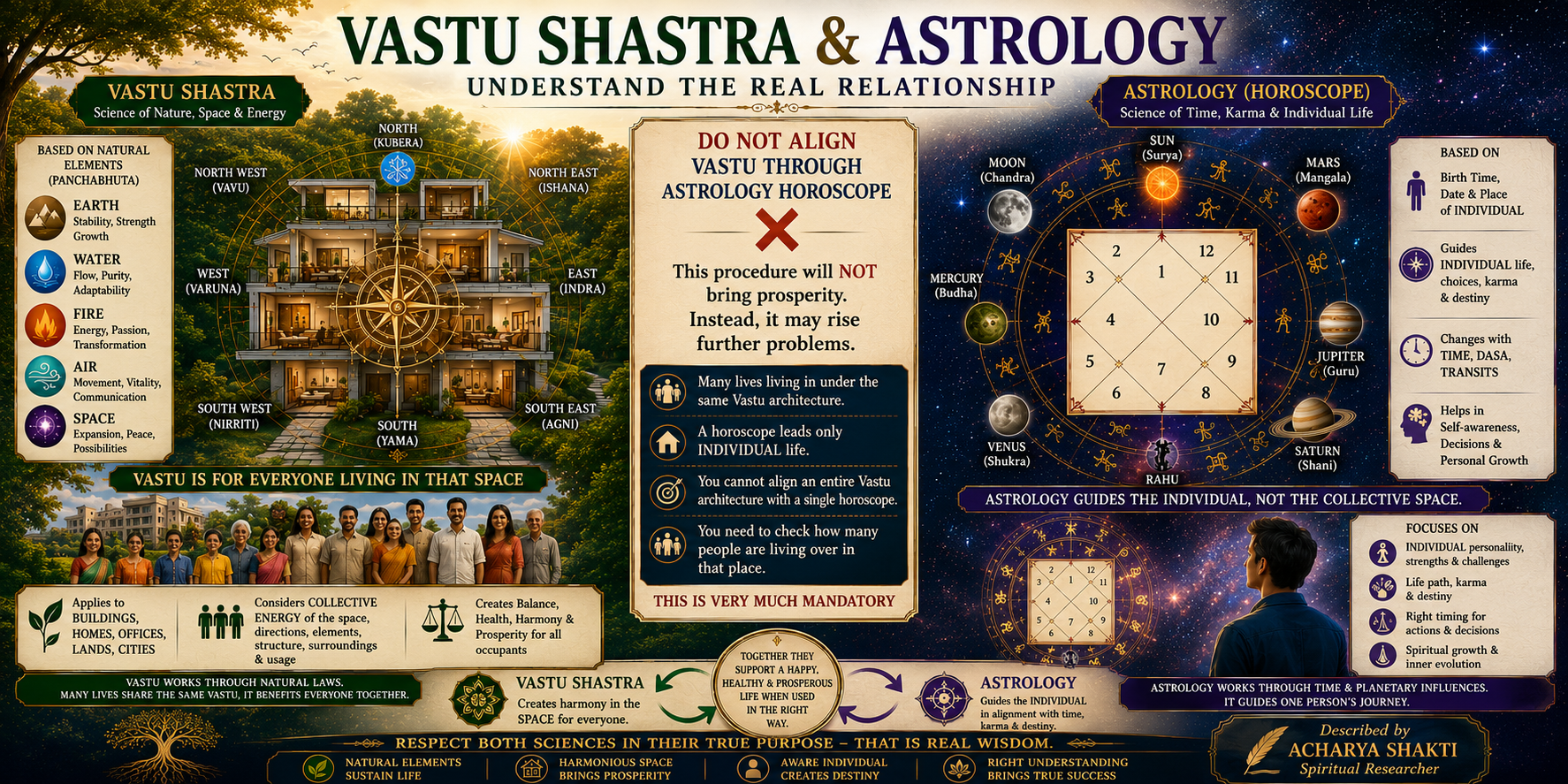
Vastu Shastra and Astrology(any other birth chart reading medium): Understanding Their True Relationship Without Confusion
By Acharya Shakti – Spiritual Researcher.
In today's world, many people believe that Vastu Shastra should be corrected or modified according to an individual's horoscope (Jyotisha/Astrology/birthchart/numeroscope/numerology). This belief has become increasingly popular through social media, commercial consultations, and misunderstood interpretations of traditional sciences. However, this approach often creates confusion and may even lead to incorrect decisions.
Both Vastu Shastra and Astrology are profound branches of ancient Indian wisdom. They are complementary sciences, but they serve different purposes. Understanding their individual roles is essential for achieving harmony, prosperity, and personal growth.
---
What is Vastu Shastra?
Vastu Shastra is the science of natural energy, space, and environmental harmony. It studies how the five natural elements (Pancha Mahabhutas)—Earth, Water, Fire, Air, and Space—interact within a physical structure.
Its primary purpose is to create an environment where every occupant can experience balance, health, peace, and prosperity.
Vastu considers:
Land selection
Building orientation
Directional energy
Natural light and ventilation
Placement of rooms
Environmental balance
Energy flow within the structure
Unlike astrology, Vastu does not depend on the birth details of any individual.
---
What is Astrology?
Astrology (Jyotisha) is the science of time and individual destiny.
It analyses:
Date of birth
Time of birth
Place of birth
Planetary positions
Dasha periods
Transits
Individual karma and life patterns
Astrology helps understand a person's:
Strengths and weaknesses
Career opportunities
Relationships
Health tendencies
Spiritual evolution
Favorable timing for important decisions
Astrology is fundamentally individual-centric, not building-centric.
---
Why Vastu Should Not Be Aligned Through an Individual Horoscope
One of the biggest misconceptions today is the belief that an entire building should be modified based on a single person's horoscope.
This idea raises an important question:
Who does that horoscope represent?
It represents only one individual, whereas a house or commercial building is shared by many people.
For example:
Parents
Children
Grandparents
Guests
Employees
Business partners
Customers
All these individuals have different birth charts, different karmic patterns, and different planetary influences.
A single horoscope cannot accurately represent the collective energy requirements of everyone using the same space.
---
Vastu Governs the Space, Not the Individual
A house remains the same regardless of who lives inside it.
Its:
Direction
Natural light
Air circulation
Structural balance
Elemental placement
affect every occupant equally.
Whether ten people live in the same home or hundreds work in the same office, the environmental energy created by the structure influences everyone.
This is why Vastu is based on universal natural principles, not individual birth charts.
---
Astrology Governs the Individual Journey
Astrology helps a person understand:
The right time to act
Personal opportunities
Challenges
Karmic lessons
Spiritual development
It does not determine the architectural energy of a building.
Just as a doctor's prescription is written for one patient and cannot be applied to an entire community, a horoscope is designed for one individual and should not be used as the sole basis for modifying a shared structure.
---
The Real Relationship Between Vastu and Astrology
Rather than replacing one another, these sciences work best when their unique roles are respected.
Vastu Shastra creates a balanced and supportive environment through the principles of nature.
Astrology helps individuals navigate their personal life journey through the understanding of time, karma, and planetary influences.
When used appropriately:
Vastu enhances the quality of the living or working space.
Astrology guides personal decisions and timing.
Together, they contribute to a balanced and meaningful life without overlapping their core principles.
---
A Scientific Perspective
From a practical standpoint, every building interacts with natural forces such as sunlight, airflow, gravity, orientation, temperature, and surrounding environmental conditions. These influences remain constant regardless of the occupants' birth details.
Therefore, evaluating a building should begin with its design, location, and relationship with natural elements—not with the horoscope of a single resident.
Likewise, personal decisions related to career, relationships, education, or spiritual growth may benefit from astrological guidance that is tailored to the individual.
Recognizing this distinction helps avoid unnecessary alterations and promotes a more logical application of both sciences.
---
Common Misconceptions
Some common misunderstandings include:
Believing one person's horoscope can determine the Vastu of an entire house.
Assuming changing a room based solely on astrology guarantees prosperity.
Ignoring natural environmental principles while focusing only on planetary influences.
Treating Vastu and Astrology as interchangeable disciplines.
Such approaches often create confusion instead of lasting solutions.
---
Conclusion
Vastu Shastra and Astrology are both invaluable treasures of ancient Indian knowledge, but they are not identical sciences.
Vastu Shastra is the science of space, nature, and collective environmental harmony.
Astrology is the science of time, karma, and the individual's life journey.
Respecting the true purpose of each discipline allows them to complement one another rather than conflict. Prosperity arises not from mixing their principles indiscriminately, but from applying each science within its rightful scope.
True wisdom lies in understanding where one science ends and the other begins.
---
About the Author
Acharya Shakti is a Spiritual Researcher dedicated to the scientific exploration of Vastu Shastra, Spiritual Psychology, Numerology, Palmistry, and ancient Indian knowledge systems. His work emphasizes logical interpretation, natural principles, and practical application while preserving the authenticity of traditional wisdom.